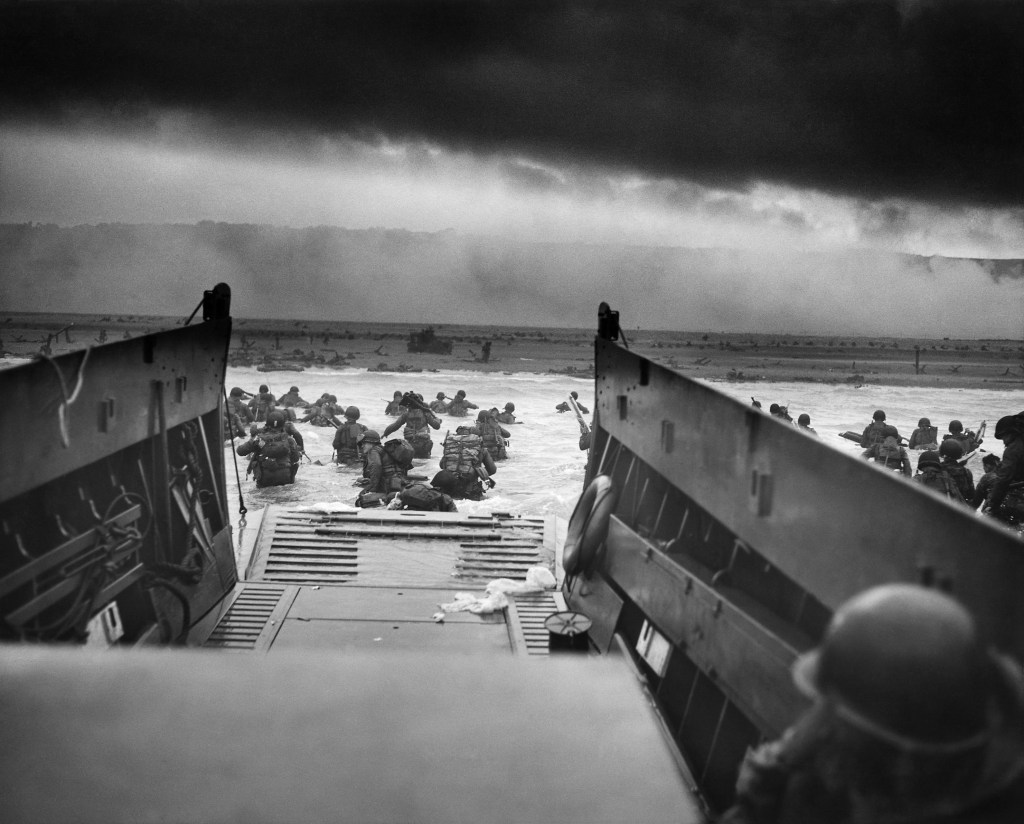
Commencement of Operation Overlord, the Allied invasion of Normandy, with the execution of Operation Neptune—commonly referred to as D-Day—the largest seaborne invasion in history.
ㅤThe Normandy landings, codenamed Operation Neptune and commonly known as D-Day, were the pivotal Allied invasion of Normandy on June 6, 1944, during World War II. As the largest seaborne invasion in history, this operation, part of the broader Operation Overlord, marked the beginning of the liberation of France and Western Europe from German occupation. Extensive planning, which began in 1943, included a significant deception campaign, Operation Bodyguard, to mislead the Germans about the intended landing site. The invasion, led by Allied commander Dwight D. Eisenhower, was delayed by 24 hours due to poor weather, a critical decision given the strict requirements for tide and moonlight. The German defense was under the command of Field Marshal Erwin Rommel, who was tasked with fortifying the Atlantic Wall.
ㅤThe invasion commenced in the early hours of June 6 with a massive aerial and naval bombardment, followed by the deployment of 24,000 airborne troops. At dawn, Allied forces began amphibious assaults on a 50-mile stretch of the Normandy coast, divided into five sectors: Utah, Omaha, Gold, Juno, and Sword. The landings were met with fierce resistance from German gun emplacements and heavily fortified beaches, resulting in substantial Allied casualties, particularly at Omaha Beach. Despite the challenges and failing to secure all their initial objectives on the first day, the Allies successfully established beachheads in all five sectors, creating a crucial foothold for the subsequent advance into France. German casualties were estimated between 4,000 and 9,000, while the Allies suffered at least 10,000 casualties, with 4,414 confirmed dead.
 Paul M. Krueger
Leave a comment