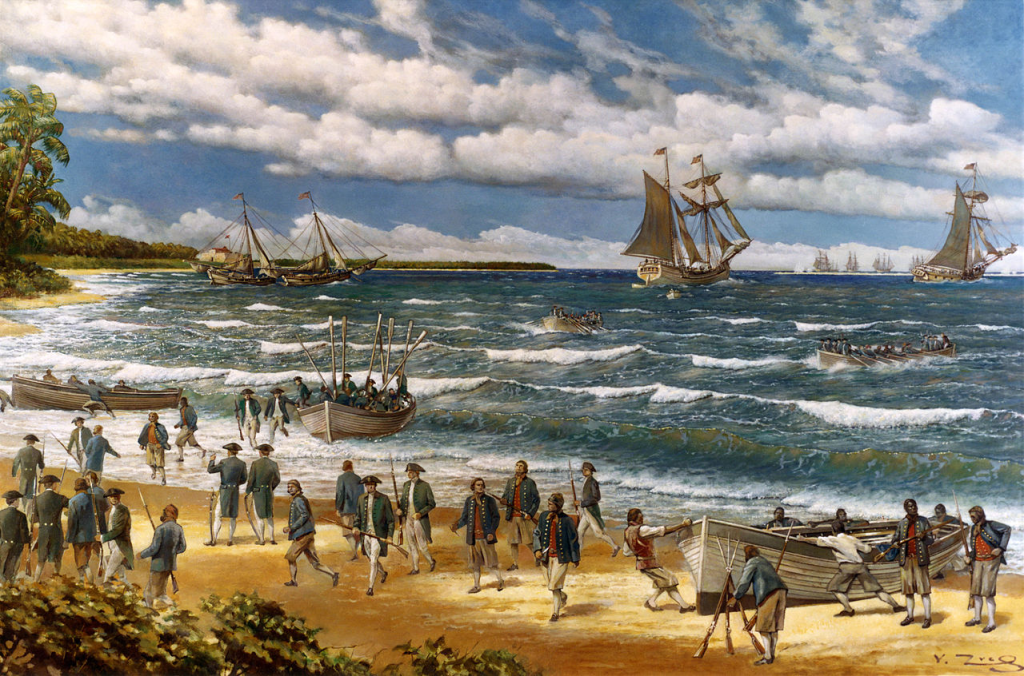
The first amphibious landing of the United States Marine Corps begins the Battle of Nassau.
ㅤThe Raid of Nassau, conducted on March 3-4, 1776, marked a pivotal moment in American military history as the first amphibious landing undertaken by the United States Marine Corps. Driven by a critical shortage of gunpowder during the American Revolutionary War, the Second Continental Congress authorized a naval expedition led by Esek Hopkins. This operation aimed to seize vital military supplies stored in the British-held port of Nassau, Bahamas. The fleet, departing Delaware in February, successfully landed two hundred Continental Marines, capturing Fort Montagu and subsequently securing Nassau itself. This bold maneuver, a direct response to the movement of gunpowder away from Virginia, showcased the fledgling nation’s determination to overcome logistical challenges in its fight for independence.
ㅤAfter occupying Nassau for two weeks, the American forces confiscated remaining military stores and departed. The subsequent encounter with HMS Glasgow proved unsuccessful, leading to investigations and courts-martial, ultimately resulting in the dismissal of Esek Hopkins. Despite these setbacks, the Raid of Nassau achieved its primary objective of acquiring much-needed supplies. However, the operational difficulties and the failure to capture the British frigate highlighted the challenges faced by the nascent Continental Navy and Marine Corps. The raid’s significance lies not only in its contribution to the war effort but also in its historical status as the inaugural amphibious operation executed by the US Marines, setting a precedent for future military endeavors.


Leave a Reply