
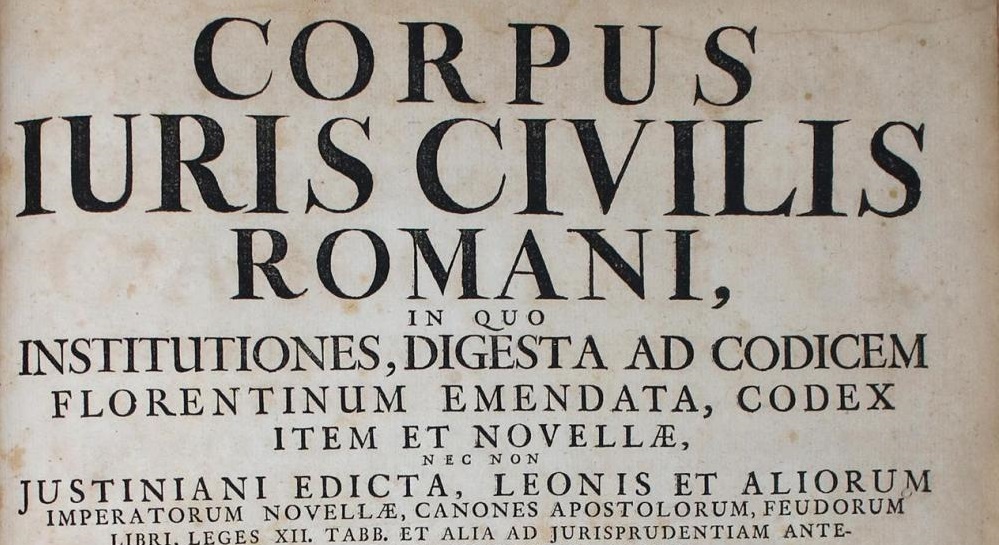
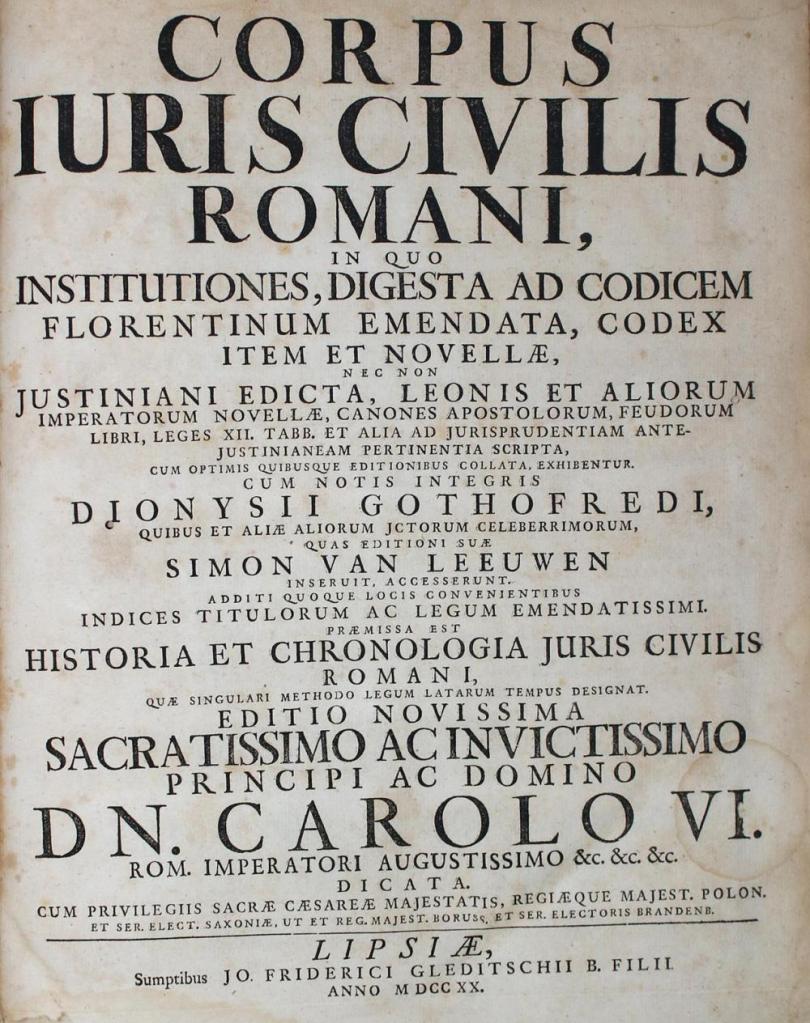
First Corpus Juris Civilis, a fundamental work in jurisprudence, is issued by Eastern Roman Emperor Justinian I.
ㅤThe Corpus Juris Civilis, meaning “Body of Civil Law,” is the modern name for a collection of fundamental legal works enacted between 529 and 534 CE by order of the Byzantine Emperor Justinian I. Directed by Tribonian, this comprehensive work was intended to be the sole source of law and initially comprised three parts: the Code (a compilation of imperial enactments), the Digest or Pandects (an encyclopedia of extracts from Roman jurists), and the Institutes (a student textbook introducing the Code). All three parts were given the force of law, and subsequent new laws enacted by Justinian are now considered a fourth part, the Novellae Constitutiones.
ㅤOriginally composed and distributed in Latin, the Corpus Juris Civilis was later revised into Greek as it became the dominant language of the Eastern Roman Empire, forming the basis of the Basilika. While not initially well-established in Western Europe, it was rediscovered in the Middle Ages and significantly influenced the development of private law in civil law jurisdictions. Its public law content was also utilized by secular and religious authorities, and its provisions even impacted Catholic canon law. Although its influence on common law systems was smaller, some concepts survived through Norman law, and it continues to hold major significance in public international law, making its four parts foundational documents of the Western legal tradition.
 Paul M. Krueger
Leave a comment