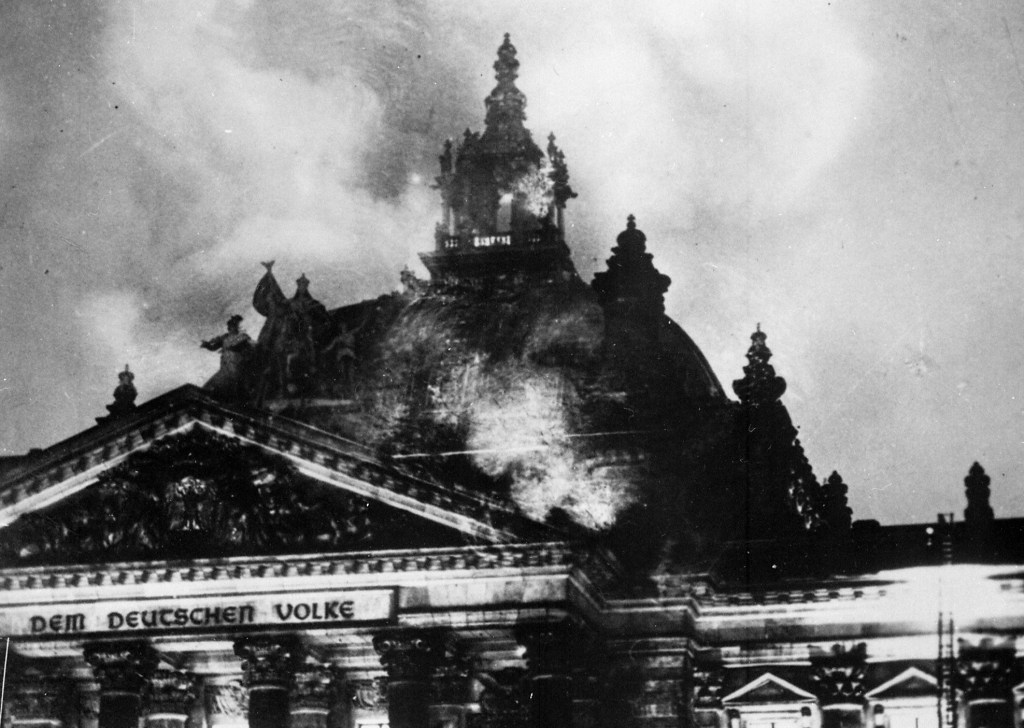
Germany’s parliament building in Berlin, the Reichstag, is set on fire; Marinus van der Lubbe, a young Dutch Communist claims responsibility.
ㅤThe Reichstag fire, an arson attack on the German parliament building in Berlin on February 27, 1933, occurred just weeks after Adolf Hitler became Chancellor. Dutch council communist Marinus van der Lubbe was apprehended at the scene. The Nazis, however, attributed the fire to communist agitators, using it as a pretext to claim a communist plot against the government. This led President Paul von Hindenburg to issue the Reichstag Fire Decree, which suspended civil liberties and enabled a crackdown on communists. The fire proved pivotal in the Nazi consolidation of power, facilitating their rise to total control of Germany.
ㅤThe fire was reported shortly after 9:00 p.m., with police and firefighters finding the building engulfed in flames and van der Lubbe inside. The subsequent Reichstag Fire Decree enabled mass arrests of communists, including Reichstag delegates, severely hindering their participation in the March 5th elections. This allowed the Nazi Party to expand their influence in the Reichstag, further aiding their seizure of power. Bulgarians Georgi Dimitrov, Vasil Tanev, and Blagoy Popov, known Comintern operatives, were also arrested, as was communist party leader Ernst Torgler. A trial ensued, resulting in the acquittal of the Bulgarians and Torgler, but van der Lubbe was convicted and executed. The responsibility for the fire remains debated, with some alleging Nazi involvement, though most historians attribute it to van der Lubbe, while acknowledging that whether he acted alone is unclear.
 Paul M. Krueger
Leave a comment